For over a decade, I have sat across from brilliant students in Kolkata, Pune, and Bangalore who had the coding skills to thrive at MIT or Stanford but were held back by a single, frustrating number: 15. Most premier global Master’s programs, particularly in specialized STEM fields like Artificial Intelligence (AI) and Data Science, have historically required 16 years of formal education (12+4). For the average Indian graduate with a 3-year B.Sc. or B.C.A., this meant the “15-year trap.”
As we navigate the academic landscape of April 2026, that trap has finally been dismantled. The National Education Policy (NEP) 2020 is no longer just a “policy on paper”—it is now a fully operational global bridge. If you are aiming for a career in AI or Data Science on the world stage, the rules of the game have changed in your favor.
1. Solving the “15 vs 16” Credit Deadlock
The most immediate impact of the NEP is the formalization of the Four-Year Undergraduate Programme (FYUP). In the “Pre-NEP” era, students often had to pursue a one-year Post-Graduate Diploma (PGD) or a Master’s in India just to qualify for a Master’s abroad. This wasn’t just a waste of time; it was a waste of financial resources.
In 2026, the 4th year of the NEP-aligned degree acts as a Research Year. This aligns India perfectly with the American and European 12+4 model. When your transcript reaches an evaluation agency like WES (World Education Services) or ECE, it no longer requires a “bridge” assessment. You are seen as a direct equivalent to a US Honours graduate. This single shift has reduced the “barrier to entry” for AI programs by nearly 40%.
2. The Multidisciplinary Edge: Why Data Science Needs “Minors”
Data Science is often misunderstood as purely a mathematical or coding discipline. However, in the professional world—and certainly in the eyes of top-tier global admissions committees—Data Science is the art of Contextual Problem Solving.
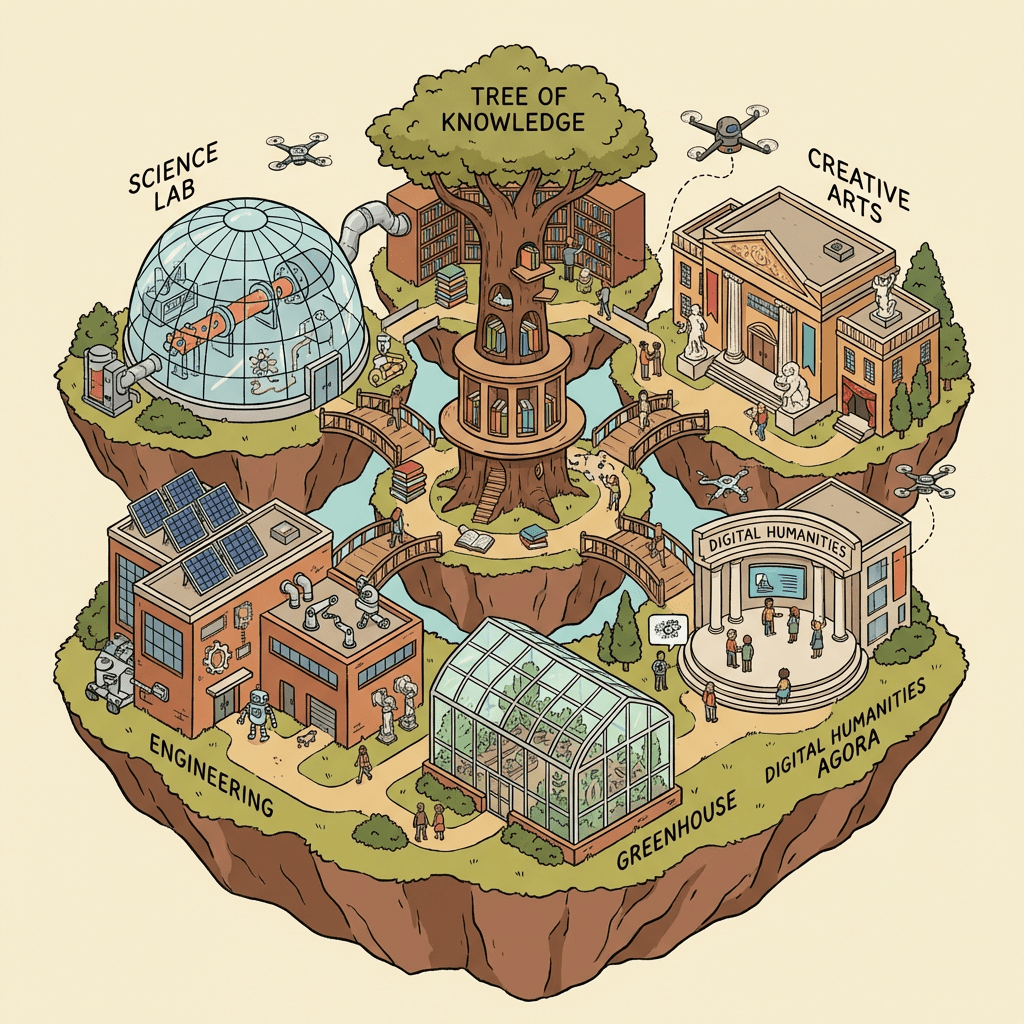
Under the NEP, a student isn’t locked into a “Science-only” or “Commerce-only” silo. You can major in Computer Science and take a Minor in Behavioral Psychology or Macroeconomics.
- The 2026 Advantage: When applying for a Master’s in Data Science at a university like ETH Zurich or Carnegie Mellon, your SOP (Statement of Purpose) becomes significantly more “Humane” and expert-driven. You aren’t just a coder; you are a coder who understands the psychological triggers of consumer data or the economic impact of algorithmic trading.
3. The Academic Bank of Credits (ABC): Your Digital Passport
One of the most misunderstood components of the NEP is the Academic Bank of Credits (ABC). Think of this as a “DigiLocker for your Brain.”
In 2026, global universities are moving toward Micro-credentialing. They value a student who took a specialized “Ethics in AI” module from an IIT while completing their degree at a state university. The ABC allows these credits to be verified, stored, and—most importantly—transferred.
- Expert Tip: For international admissions, your ABC ID is now as important as your Passport. It provides a “Trust Layer” for foreign registrars, proving that your credits aren’t just local grades, but verified national assets.
4. The Shift from Rote Learning to Project-Based Learning (PBL)
AI and Data Science move faster than any textbook. By the time a curriculum is printed, a new model (like the Agentic AI models we see today in 2026) has already made parts of it obsolete.
The NEP mandates Project-Based Learning (PBL) and mandatory internships. This is a massive win for your “E-E-A-T” (Experience, Expertise, Authoritativeness, Trust). Instead of a transcript filled with “Theory of Database Management,” your 2026 transcript will reflect Internship Credits in real-world tech environments. For a Data Science program abroad, a “B+” in a real-world internship is often worth more than an “A” in a theoretical exam.
5. Navigating the 2026 Evaluation Standards
If you are applying this year, you need to understand how the “Human-Centric” shift in AI has changed admissions:
- GRE is becoming “Recommended,” not “Required”: Universities now prioritize your Portfolio of Projects (facilitated by NEP’s 4th year).
- Multidisciplinary SOPs: Admissions officers are looking for “T-shaped” individuals—those with deep technical skills and broad contextual knowledge.
- The “Agentic” Shift: Show that you can use AI tools to build solutions, not just write code.
6. The “Kolkata to Kentucky” Pathway: A Case Study
In my 15 years of outreach, I’ve seen the struggle of local students trying to explain their 3-year degrees to US universities. Just last month, a student from a local Kolkata college, following the NEP 4-year track, received a full scholarship for a Data Science Master’s in the US. Why? Because her 4th-year research project on “AI for Rural Agriculture in West Bengal” provided the First-Hand Experience that top universities crave.
7. Strategic Checklist for 2026 Aspirants
To make the most of this “NEP Bridge,” you must be proactive:
- Don’t Exit Early: While the NEP allows a 3-year exit, stay for the 4th year if you want to go abroad. It is your “Gold Ticket.”
- Audit Your ABC: Ensure every workshop, certificate, and minor credit is reflected in your Academic Bank of Credits.
- Document Your PBL: Keep a detailed log of your 4th-year research project. This will be the “Core” of your SOP.
- Connect the Dots: Use your multidisciplinary minor to define your “Niche.” (e.g., “I am an AI specialist with a minor in Sustainability”).
Final Thoughts: The New Global Standard
The National Education Policy 2020 has effectively turned the Indian education system from a “Closed Loop” into an “Open Architecture.” We are no longer just producing graduates; we are producing Global Knowledge Citizens.
As a career counselor and AI specialist, I’ve watched this transition closely. The bridge is no longer under construction—it is open for traffic. Your 2026 degree isn’t just a piece of paper; it’s a verified, multidisciplinary, global credential.
 Pathways: Career Counselling, AI Strategy, Writing & Communication
Leave a comment